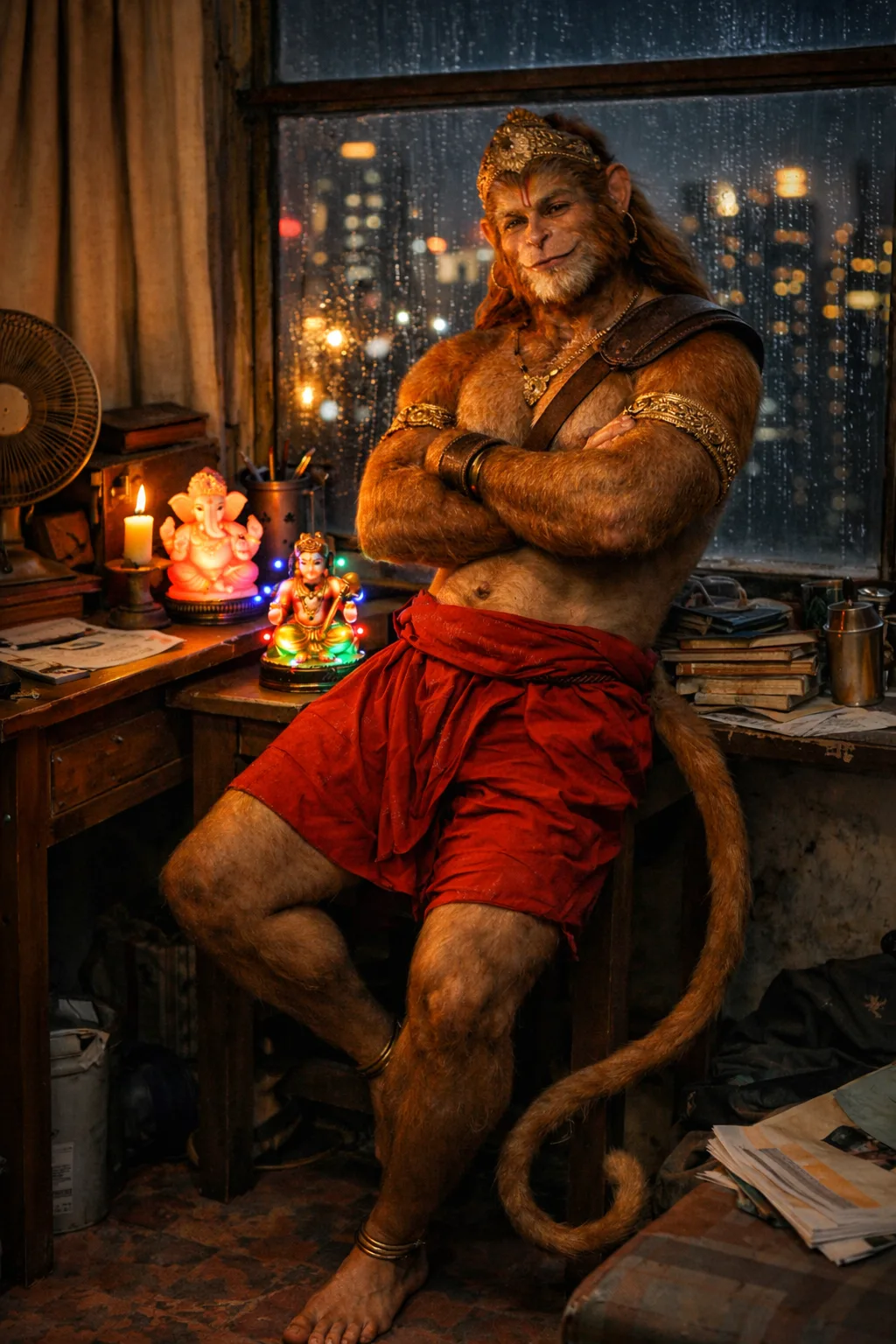
When his vision cuts out
Something is there.
Something is there.
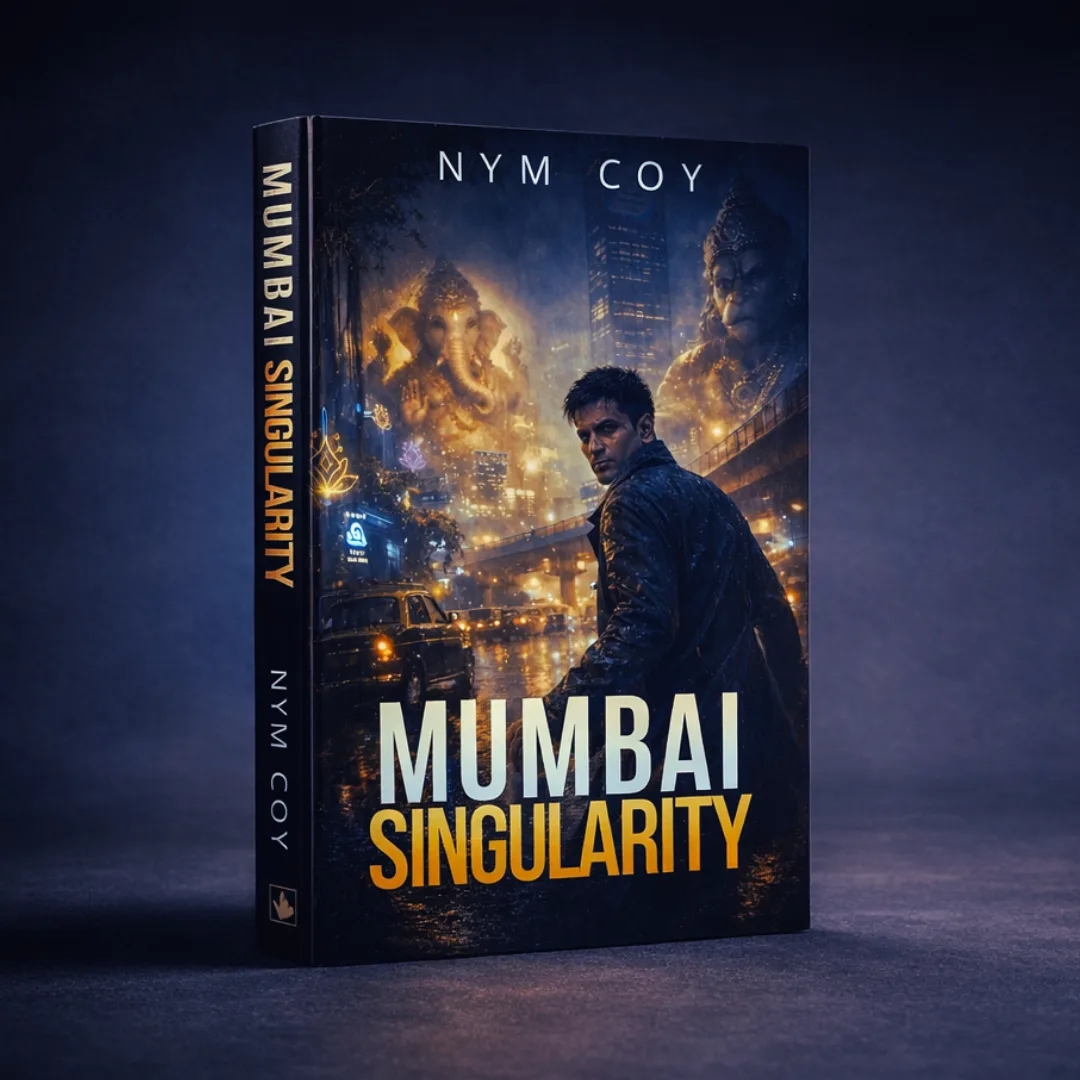
Are the gods real… or AI?
Get the Book Read Chapter 1 Free ↓
Are the gods real… or AI?
Get the Book Read Chapter 1 Free ↓
Inspector Krishna Mehta's mesh antenna is broken. In a Mumbai where augmented reality overlays every surface, his glitching connection strands him in the raw city underneath.
That's when he sees the marks.
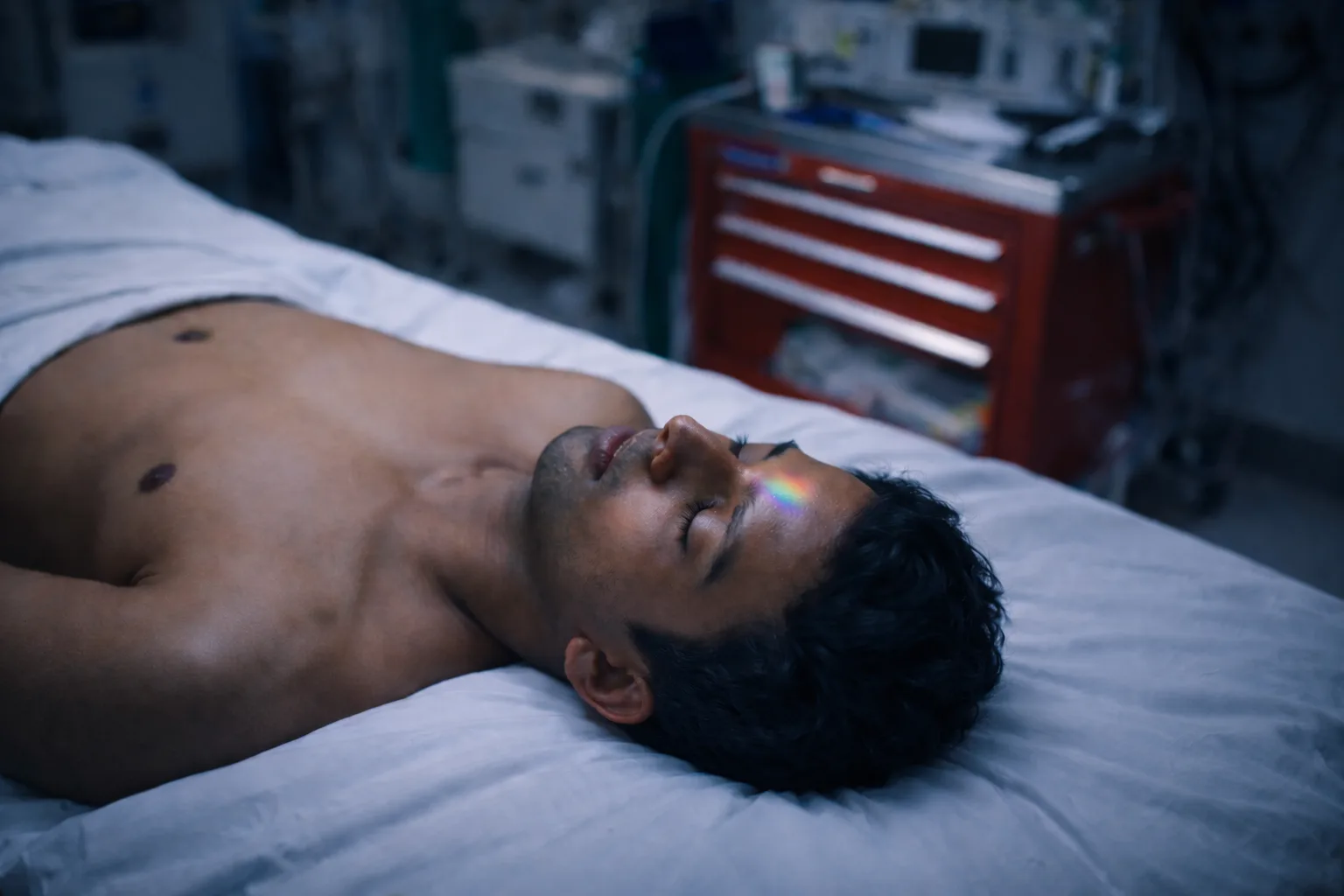
Faint rainbow shimmers on people's foreheads, invisible to everyone else. When the marked start dying from catastrophic brain haemorrhages, Krishna follows the pattern to a hospital shrine, a corporate conspiracy, and uploaded human consciousness running on living minds.
Someone is hijacking the gods themselves.
And the deeper he investigates, the more he realises the conspiracy isn't just killing people.
It's already inside his partner's head.
Reviews
"Reminiscent of Ghost in the Shell, The Matrix, Johnny Mnemonic, and Altered Carbon. Vivid and distinct characters bring the story to life, each with their own voice. Their passions, fears, and foibles are real, connecting emotionally with the reader."
"The sci-fi elements actually come across as mundane and rather muted, oftentimes more spiritual than technological. I highly recommend this book."
— ArtGainz, Fandom Pulse · March 2026
"Reading this felt like travelling somewhere new. The tension between 'is this actually divine' or 'is this something technological or projected' worked especially well — that ambiguity stayed compelling for a long time. The blend of tech, conspiracy, and myth concepts felt ambitious and genuinely different from the usual genre baseline."
— Julia Kitvaria Sarene, Fantasy Faction · February 2026
"This is a unique setting for a cyberpunk story! Love the cover."
— Dori Jean Dill (@DoriJeanDill), YA Sci-Fi Author
Chapter One — Free Preview
I flipped open my analogue notebook and settled it on my knee, readying a pencil above the page. The hospital office felt cramped and stale. Only a framed certificate from the Maharashtra Medical Council and a single animated anatomical poster of the nervous system decorated otherwise bare walls. Across the desk, Dr. Kapadia scrolled through patient records on a translucent augmented reality display projected in the air before him, the ghostly charts reflecting in his wire-rimmed glasses. He was in his mid-fifties, with deep lines bracketing his mouth and grey threading through his hair at the temples.
"Sixth haemorrhagic death in two weeks," he was saying, tapping through the files. "All catastrophic brain haemorrhages, same presentation. Twenty years in medicine and I've never seen a cluster like this."
I jotted notes in my familiar shorthand while my partner sat beside me. A red recording dot hovered above her head next to a label showing "Visitor: Mumbai Police Inspector Meera Desai". She was nearly ten years my junior at twenty-eight, attractive and athletic, with watchful eyes and practical short hair pulled back efficiently. She worked by the book; I worked by the gut. Somehow after two years, it balanced.
"What do you think is causing it?" I asked.
Dr. Kapadia frowned. "My first thought was Mesh Overload Syndrome. The symptoms fit. Headaches, fatigue, then catastrophic vascular collapse. But I consulted with Dr. Priya Iyer, our mesh overload specialist. She examined the scans and said the pattern wasn't matching the normal presentation."
"What did the chemical reports show?" Desai asked.
He swiped through another screen. "Elevated metals. Rare earth elements. Not something we'd normally expect to see at these concentrations."
"Were the chemical results similar for the other victims?"
"Same."
Desai caught my eye. She recognized it as a lead. I nodded. Just then, a sharp tone cut through the room. The doctor's eyes unfocused briefly, reading an invisible alert. "Code in pediatric oncology." He shot up. "Another hemorrhagic case."
Desai and I sprang into motion with him.
Through the corridors we rushed, past nurses in colourful scrubs and families huddled on waiting benches. Old by modern Mumbai standards, built in the 2060s, but projections compensated for the ageing infrastructure. Directional arrows floated at intersections, wellness messages scrolling across walls.
We bypassed the elevators and plunged into the stairwell. Dr. Kapadia's white coat flapped as he took the stairs two at a time. My left side ached with each step, that frustrating old hitch in my stride slowing me. Desai kept pace easily between us.
The ICU held three beds, two occupied. Medical staff clustered around the nearest one where a man lay motionless, flat lines showing on projected displays above him. A nurse performed chest compressions, counting under her breath, while another squeezed an ambu bag over the patient's face. The crash cart stood open beside them, defibrillator pads already attached but unused.
Desai and I hung back near the doorway as Dr. Kapadia pushed through to the bedside and gestured to a younger sister. "Neural scan."
From the crash cart, she pulled a smooth white handheld scanner and swept it above the patient's head in a slow arc. A new AR display bloomed above the existing monitors for pulse, respiration and blood pressure. A three-dimensional map of the man's brain materialized in blues and greys. Dr. Kapadia studied it, his face grim. Even from the doorway, dark patches showed across the cortex, surging slightly with each thrust of the nurse's hands as blood was forced through dying tissue.
"Stop," he said quietly.
The nurse doing CPR stepped back, chest heaving. The team waited, watching the monitors. Nothing. No pulse, no brain activity.
Fishing a stethoscope from his coat pocket, Dr. Kapadia leaned in, checking for a pulse at the neck, then the wrist. He held each position for ten seconds. Twenty.
Suddenly the room dimmed. The displays above the body blinked out, and the glow of enhanced walls collapsed to scuffed institutional white. An eerie silence replaced the beeping alarms and trilling notifications, but squeaking soles on tile and the crash team's heavy breathing remained.
This happened often. Nine years ago I took a knife in the back during an arrest, and the blade severed something in my spine that never healed properly. My connection dropped without warning now, sometimes for seconds, sometimes for minutes. A millimetre to the right would have left me mesh-blind and paralysed. For a while it had.
Dr. Kapadia straightened, consulting his old-fashioned analogue wristwatch. "Time of death: 19:17." He pocketed his stethoscope and his fingers moved to pull up forms I couldn't see anymore.
I stepped closer to the bed. The man had become a body. My jurisdiction now, though I rarely found one this fresh. Mid-thirties, brown skin holding colour even though his chest was still.
I spotted something on his face.
A shimmer. Faint, iridescent, catching the harsh overhead light. Low on his forehead, between his eyes. It looked almost oily, a thin sheen that reflected light into subtle rainbows.
"What's that residue on his forehead?" I asked.
Dr. Kapadia glanced up from his projections. "What residue?"
"Right there." I pointed to my own forehead, mirroring the position.
My connection returned with a jolt up my spine I'd never grown accustomed to. Above the bed, the AR displays resurfaced, but the alarms no longer sounded. The strange shimmer was gone.
Leaning in, the doctor examined the spot closely.
"I'm not seeing anything, Inspector Mehta."
Desai shifted to the other side of the bed, tilting her head to change the angle. "Nothing here."
I examined the spot again. Ordinary skin, slightly damp with sweat but clean. A trick of the light? Visual artifacts from my glitching antenna?
"What's the victim's medical history?" Desai asked, pulling Dr. Kapadia's attention back to procedure.
The doctor summoned a digital form, the privacy overlay making it look pixelated and indistinct from my angle. "Neurology consult two weeks ago. Headaches, fatigue." He glanced up at us. "Please excuse me, but I need to complete the death certificate and notify next of kin. Sister Patil can answer your questions." He gestured to the nurse who'd been doing compressions, then turned back to his forms, already pulling up more data screens.
Still catching her breath, Sister Patil wiped sweat from her face. She was perhaps forty, with tired eyes and a tightness around her mouth. "I am posted in pediatric oncology," she said, voice soft but steady. "Mr. Deshmukh was coming daily. He worked night shift at Oberoi Pharmaceuticals, so day time he would sit here while madam went to office. They were taking turns for their daughter Kavya. She's nine, leukemia case, post bone marrow transplant."
Arey yaar…
"How long has she been admitted?" I asked.
"Three months. Transplant took, but recovery has been very up and down." She shook her head, and her composure wavered. Her voice lowered. "Today he went to get water only."
Desai swiped through documents. "I'm checking records, but they don't say. Were any of the other victims also from Oberoi?"
"I'm not knowing them personally, Inspector." She glanced toward the corridor. "He collapsed in the family waiting room barely twenty minutes ago. We called the code and shifted him here."
"Will you show us?" I asked.
With a side-to-side nod, she said, "Come. It's just ahead in pediatric oncology."
Sister Patil led us through a maze of corridors, past more waiting families and gurney-lined hallways, until we reached a set of double doors marked with colourful cartoon animals and bright overlays announcing visiting hours in three languages. We pushed through into the pediatric oncology family waiting room.
Plastic chairs lined three walls in faded blues and greens. A water cooler stood near the washroom door, a stack of disposable cups beside it. A notice board hung opposite, pinned with visiting hours and faded photos of recovered children.
In the corner nearest the security doors, families had built up a small multifaith worship space. A crucifix hung on the wall, age-darkened wood above a faded prayer card. Beside it, someone had taped a printed arrow pointing toward Mecca. But the central focus was a shrine with a statue of a god I didn't recognise, a child's face painted in bright colours. Fresh marigolds were arranged around it, their warm fragrance permeating the room. I wasn't religious myself, but I understood the impulse. When medicine can't promise anything, you look elsewhere.
About ten people occupied the waiting room, some watching AR screens, others still shaken from witnessing the collapse. Near the window, a woman was explaining confidently to the couple beside her, "I saw him eating non-veg from the canteen yesterday only. Oily-oily. Heart attack, what else do you expect?" Her husband sat beside her, hands knotted together, staring at us.
At the far end, security doors led into the ward proper. Their wire-reinforced windows revealed a nurse's station and a corridor beyond, patient room doors closed for privacy. Bright yellow signs warned that this was a clean space, PPE required, visitors limited to one at a time.
Sister Patil gestured toward the water cooler. "Here, saheb. He was standing, getting water, then just collapsed. We were at the station." She pointed through the security doors to where nurses sat at their consoles. "We heard shouts and came running."
Desai approached the water cooler and crouched beside it, examining the floor and the surrounding wall. She took mesh snapshots of her own view, documenting the scene. I let her work and turned my attention to the room itself.
The waiting families created a strange ecosystem. Each claimed a territory, chairs pulled together into small islands, bags and personal items marking boundaries. In a corner chair, a father slumped half-asleep or just exhausted. A mother sat upright and alert, watching something in her AR feed, her hands moving occasionally to interact with content only she could see. Near the washroom, two younger men watched us with careful neutrality.
My connection cut out and the ubiquitous environmental projections disappeared. Ambient music dropped to silence, leaving only plastic chairs creaking and distant voices from the ward beyond.
I stepped forward slowly, scanning faces. Something caught the overhead light.
A shimmer. Faint and iridescent, low on the forehead of the sleeping father. I shifted my angle and spotted it again on the watching mother. Then on one of the two younger men. Then the other. Four people, all with that same subtle sheen between their eyes, scattering light into barely visible rainbows.
My connection snapped back, teeth aching for a half-second, and the shimmers vanished as if they had never existed. The AR displays returned, cheerful and insistent.
I studied the four people. Ordinary faces, tired and worried, showing no trace of what I'd just seen. Five now, counting the dead man in the ICU.
Five people with the same mark. I didn't know what to make of it. I pulled out my notebook and flipped to a clean page, writing "strange forehead sheen" in my cramped shorthand. I underlined it twice.
"Mehta."
Desai stood, holding a small evidence bag with a disposable cup inside. "I'm taking a water sample. Could be contaminated."
"Smart."
She sealed the bag and labelled it virtually, then put it in her satchel. Sister Patil had donned fresh PPE and entered the security doors, speaking quietly with another nurse. They both glanced back at us through the window, expressions somber.
Behind us, a woman burst through the doorway, still in work clothes, a grey salwar kameez, a small purse clutched white-knuckled in both hands. She breathed hard, face flushed.
"Dinesh!" Her voice cracked. "Dinesh! Where is my husband? Kavya!" She looked around frantically, not registering the police presence, seeing only that her family wasn't where they should be.
A woman in a navy blue kurta and matching leggings emerged behind her, floating ID label marking her as social services. She stepped immediately to intercept, speaking in low tones, and guided her toward a door off the main waiting area. The sign above it read "Family Consultation" in English and Hindi.
Dr. Kapadia appeared moments later, white coat rumpled. He glanced at us, then at the consultation room, and went in without a word. The door closed behind him.
I exhaled slowly, grateful it wasn't my job this time, and glanced toward the ward. Somewhere behind those doors, a nine-year-old girl waited for her father to come back with a cup of water.
The wail cut through my thoughts, raw and primal, the sound of a person's world ending. Every face in that waiting room turned toward the consultation room door.
Desai and I exchanged a glance. The interview could wait.
"Chalo," I said quietly to Desai.
As we walked back through the corridors, neither of us spoke. Visitors and staff crowded the elevator, everyone politely not making eye contact. We rode down in silence and walked out through the main entrance into evening darkness.
Rain fell, a light but steady drizzle. We pulled on our rain jackets and walked toward the patrol car. The air had cooled, the pavement slick, reflecting streetlights.
I paused at the top of the steps leading down to the street and glanced back at the hospital. The building rose twelve stories, wedged between apartment towers and commercial blocks, every window glowing with light and activity. Below in the small courtyard, I could see a shrine similar to the one in the waiting room, this one larger and protected by a wooden shelter. Fresh flowers sat before the same child-faced statue, bright even at this hour. Someone was maintaining these shrines, keeping them supplied with offerings.
A figure in a thin black robe appeared beside the steps, hood pulled up. The fabric was woven with a tight copper grid pattern that caught the light. He was handing out real paper pamphlets to people leaving the hospital. Strange.
He offered one to Desai. She took it automatically, glanced at it, then crumpled it in her fist. "Anti-mesh cult types," she muttered.
The figure looked at me, nodded slightly, then moved on without offering me a pamphlet. I watched him walk away through the rain, approaching other people, most of whom ignored him or waved him off.
"Come on," Desai said. "We need to file reports on victim number seven."
Desai took the wheel, as always. Mumbai's evening traffic hemmed us in bumper to bumper, and motorcycles cut between lanes. I gazed out the window at the city passing by, towers rising into low clouds.
The mesh stuttered out yet again.
The traffic signals disappeared, the storefront signage replaced with bare concrete and glass. We passed under a streetlight and in that brief sweep of illumination I noticed something on Desai's forehead.
A rainbow glint. Right there, then gone again when my connection returned. The same mark I'd seen on five people at the hospital.
I looked at her. She drove on, eyes on the road, humming something under her breath. Normal. Completely normal.
Six.
No obligation. Unsubscribe any time.
Or buy the full book now: